> For the complete documentation index, see [llms.txt](https://cryptoexcel.gitbook.io/documentation/llms.txt). Markdown versions of documentation pages are available by appending `.md` to page URLs; this page is available as [Markdown](https://cryptoexcel.gitbook.io/documentation/en/5-generate-automated-positions.md).
# 5) Generate automated positions
The step-by-step tutorial to get started with Crypto Excel.
In the previous section (see [4) Set up exit positions](/documentation/en/4-set-up-exit-positions.md)), we manually configured exit positions, which has two limitations:
* it is not always easy to know what target prices to set;
* you must establish a strategy for each cryptocurrency in your portfolio and update these values whenever the market changes.
We will now explore a more effective method, where exit positions are generated automatically.
## I) Automatic strategy, for each cryptocurrency
Click the “Sell alerts” button to open the “Generate automated positions” pop-up window.
“Generate automated positions” window
* **Gain multiplier relative to the average purchase price**
* In the first line, enter the multiplier coefficients corresponding to your target returns (relative to your average purchase price). Crypto Excel will then automatically calculate the price targets for each cryptocurrency in your portfolio.
* For example: x2 in TP1 and x0.75 in SL.
* You will be notified when your gains have doubled or when you have suffered a loss of 25%.
{% hint style="warning" %}
* The coefficients in the Take Profit 1-2-3 fields must be greater than 1.
* The coefficient in the Stop Loss field must be between 0 and 1.
{% endhint %}
- **Exit percentage**
* In the second line, set the exit percentage, as explained previously in [4) Set up exit positions](/documentation/en/4-set-up-exit-positions.md).
* **Minimum Profit / Loss condition**
* More information is available in the following section [6) Get notified by sell alerts](/documentation/en/6-get-notified-by-sell-alerts.md).
> *Double-click or press the “F” key to display the video in full screen.*
{% embed url="" %}
Configure your automatic exit positions by clicking the “Sell Alerts” button.
{% endembed %}
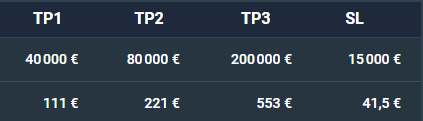
Once the first two lines have been completed, Crypto Excel automatically fills in the TP1, TP2, TP3, and SL fields for all cryptocurrencies in your portfolio (as well as those you add later).
Values have been generated for each cryptocurrency based on their average purchase price.
### Priority on manual strategy
Automatic exit positions do not override those you have configured manually (see [4) Set up exit positions](/documentation/en/4-set-up-exit-positions.md)).
{% hint style="success" %}
This allows you to combine the two approaches, for example:
* For most of your cryptocurrencies
* -> Automatic strategy
* For your main positions or those you are familiar with
* -> Manual strategy
{% endhint %}
> *Double-click or press the “F” key to display the video in full screen.*
{% embed url="" %}
Solana has automatic exit positions, which are replaced as soon as you set manual thresholds.
{% endembed %}
In the next section, we will detail how sell alerts are displayed when a target is reached (see [6) Get notified by sell alerts](/documentation/en/6-get-notified-by-sell-alerts.md))
***
## II) Strategy examples
This section covers both:
* manual strategies (see [4) Set up exit positions](/documentation/en/4-set-up-exit-positions.md))
* automatic strategies (see [5) Generate automated positions](/documentation/en/5-generate-automated-positions.md))
### Hold / scale-in
{% hint style="info" %}
* The term “**hold**” is widely used to refer to a **long-term investment strategy**. It consists of buying a cryptocurrency and holding it for an extended period – often several years – rather than selling it quickly to profit from short-term fluctuations.
* This approach contrasts with **short-term trading**, which is more demanding, requires in-depth expertise in cryptocurrencies and financial markets, and can be particularly stressful.
* **Scale-in** involves gradually increasing your position over time, for example through monthly contributions, which automatically increases your exposure to this asset.
{% endhint %}
* This approach, which is relatively passive and requires few skills, has proven successful with assets such as Bitcoin, which remains on a long-term upward trend.
* However, it is **unsuitable for most altcoins**, which generally do not withstand a bear market.
* That said, even for Bitcoin, performance can be improved by taking advantage of market fluctuations.
**In Crypto Excel:**
{% hint style="warning" %}
* As mentioned above, if you choose to apply this strategy, we recommend limiting it to **Bitcoin or assets in the Top 10**.
{% endhint %}
* There is no need to set any **TP1-2-3** target prices.
* That said, you might want to secure a **Stop-Loss (SL)** to anticipate a market reversal.
### Scale-out
* Unlike “scale-in,” “scale-out” means gradually decreasing your exposure.
{% hint style="success" %}
This approach has the advantage of reducing overall risk as you gradually scale down your position, whether it is in profit or at a loss.
{% endhint %}
**In Crypto Excel:**
* This is precisely the philosophy behind the TP1-2-3 target prices.
* The goal is to secure your initial gains by converting your assets into **stablecoins** or **fiat currencies**.
* For example, you can set TP3 at 95% of what you estimate to be the market top, then adjust TP2 and TP1 levels accordingly.
{% hint style="info" %}
Crypto Excel members also have access to a **Discord server** to share their strategies and configurations. [Click here to join](https://discord.com/invite/Mz4jcRe).
{% endhint %}
### SHAD: Sell Half at Double
If you’re unsure about when to sell, the **SHAD method** – a specific example of a **scale-out** – offers a simple strategy: **when your investment doubles (x2), sell half of your position**.
{% hint style="success" %}
Like a standard scale-out, this method significantly **reduces risk**.
* After the first sale, you recover your **initial investment** while keeping **50% of your crypto**, leaving room for potential further gains.
* At this point, you are already **breakeven** (no profit, no loss).
The following targets help you continue to secure and grow your gains:
* x4 : **double** your initial stake while keeping **25%** of your position..
* x8 : **achieve** x3 on your initial investment while retaining **12.5%** of the position..
{% endhint %}
**In Crypto Excel:**
* To apply the SHAD method, use the **automatic strategy** introduced previously [#i-automatic-strategy-for-each-cryptocurrency](#i-automatic-strategy-for-each-cryptocurrency "mention")
* For the gain multipliers, enter:
* TP1: **x2**
* TP2: **x4**
* TP3: **x8**
* For the exit percentage:
* **50%** for each TP target
{% hint style="info" %}
* The SHAD method does not specify a particular **Stop-Loss (SL)** threshold.
* You can adjust it according to your risk tolerance.
{% endhint %}
{% hint style="success" %}
* Here’s a thought experiment to compare performance.
* In a bull market, if you decide not to sell after reaching TP1 and choose to wait:
* at TP2: you achieve a **x2** while still holding **50%** of your position.
* at TP3: you achieve a **x4** while still holding **50%** of your position.
{% endhint %}
{% hint style="warning" %}
* **Warning**: not applying the strategy can increase gains, but also risks.
* If the market reverses before reaching TP2 or TP3, you may incur losses.
* It is up to you to assess whether TP2 and TP3 targets are **realistic and achievable**, keeping in mind that they are calculated based on your **average purchase price**.
{% endhint %}
***
Please feel free to ask questions if you need to. We will continue to expand this documentation based on your feedback.